



Article written by Lucy Stokes
In Queensland, rugby league isn’t just a game — it’s part of who we are.
The game lives in the way communities rally around each other without needing to be asked. In the volunteers who show up before dawn to mark the fields and stay long after the final whistle to pack up the gear.
“It’s a tough sport,” Roger Whyte says, “but it teaches young people discipline and loyalty, but most importantly, it instils confidence and camaraderie.”
For Roger, rugby league became a way to give back. For decades, he has used the game to create opportunities for others, to open doors, to build connections, to give young people a sense of belonging they might not find anywhere else. Not for recognition, and never for reward, but because he believes it is simply what you are meant to do.
“There’s a million Rogers out there,” he humbly offers, though few that have left quite the impact of Roger Whyte.
In every town, in every club and every community, there are people who step up and give their time without thinking twice about it. But what Roger has quietly built over decades tells a bigger story about what that kind of commitment looks like in practice, and the impact it can have.
Over 42 years in the Queensland Police Service, Roger rose to the rank of Chief Inspector of the Southern Patrol Group. He moved frequently, carrying his family from one Queensland community to the next, building a career of service that was a life’s work in itself.

But alongside it, for more than three decades, Roger contributed over 30 hours a week to rugby league at every level of the game. He spent those years unifying junior and senior competitions, strengthening governance, expanding access for players in remote communities, and growing the game for young females. He also found time for Rotary, community alliances, and parents and friends associations across the state.
In 2026, Roger was awarded the Queensland Lifetime Contribution to Volunteering Award recognising an extraordinary, lifelong commitment to community across the state. The honour sits alongside his 2025 NRL Volunteer of the Year recognition, as well as the Australian Police Medal, awarded in the 2026 Australia Day Honours for distinguished service following his retirement from the Queensland Police Service.
Forty-two years of policing across regional Queensland is an education in the full range of human experiences. Roger worked in communities where opportunity was thin and disadvantage ran deep. He saw, across decades, what happened when young people had no anchor. When isolation or circumstance put the game and everything it could offer, out of reach.
“Rugby league serves as a powerful vehicle for positive change,” he says, “instilling values of teamwork, discipline, and resilience. The influence our former NRL players have, combined with the education and training provided by our various partners and agencies, gives me confidence that we’re giving these kids the best chance to change their futures.”
The policing and volunteering were never really separate in Roger’s mind. They were two expressions of the same obligation; to do something useful with the community you find yourself in.
Moving from posting to posting also gave Roger something less obvious: a firsthand understanding of what sport means to a kid who’s been uprooted. He’s certain rugby league gave his own sons resilience and belonging every time they landed somewhere new.
As for balancing a full-time career with 30 hours of weekly volunteering for three decades? He credits one person above all else.
“A very understanding wife.”
Out of decades spent working with young people facing immense disadvantages, the Helping Hands Mentoring Program emerged as a focused response designed to intervene early and offer a different path. The program was first trialled in 2019 in an abridged form, before COVID-19 disrupted its progress in 2020. It returned in 2023–2024, bigger and better, delivered over two years with the support of many stakeholders.
During this time, Roger led the Helping Hands Mentoring Program in partnership with Queensland Police, the NRL, QRL, the Cowboys, and many other private and public sector organisations.
Roger began entering a youth detention facility alongside former NRL players, running rugby league drills unlike anything the program had seen before. For the young people involved, it became more than just training—it was something to anticipate, bringing structure and a renewed sense of purpose within a confined environment. They were invited to design their own apparel, earning the right to wear it after completing the sessions—turning participation into something visible and earned.
“We would ensure that once they were released, they were given a lifeline to play footy rather than go back to a life of crime.”
The Helping Hands program also paid fees, sourced boots, and connected players to clubs after release, working alongside Legal Aid to help ease the transition. For remote communities, the work extended even further. Roger recounts how former Cowboys player Michael Morgan travelled with him to Mount Isa to engage stakeholders and secure funding, helping send young people from isolated areas to the QRL Rise professional development program. He also worked to secure sponsorships to support their attendance at elite pathway carnivals, removing financial barriers that had previously kept them out.
“It’s just us, volunteers,” he says. “No one got paid, nor should we. But it was very labour intensive, and it made a lot of people happy.”
Ask Roger what rugby league actually does for a young person sitting at the edge of a bad decision, and his answer is immediate and layered.
“It’s not for the faint-hearted. It’s a tough sport, a very physical sport, but it teaches young people discipline and loyalty, which is a trait we don’t see too often in our world. And more importantly, it instils confidence and camaraderie.”
He talks about resilience, mental and physical. About dignity, and what it means to conduct yourself well when you’re losing a game and you have to make one more tackle you have nothing left for. About being part of something that requires every individual to contribute, not for themselves, but for the team.
“It’s not necessarily about win, win, win,” he says. “It’s about playing with your mates and having fun. If kids can do that, I think that makes them a better human being and maybe better equipped to contribute to our community.”
There is one question that quietly underpins everything Roger has built, the one that can’t be answered with a metric or a recidivism rate, but that he keeps returning anyway.
“While they’re busy playing rugby league — how many offences didn’t they commit?”
The delivery of the Helping Hands program was built on a clear principle: credibility. It recognises that who delivers the message can matter just as much, if not more, than the message itself. That’s why former NRL and QRL players were not an add-on, but at the centre of every session.
Roger points to former Cowboys star Matt Bowen as one of the program’s most influential voices. Growing up in Hope Vale before going on to play more than 300 NRL games, Bowen brought an authenticity that resonated immediately. When he walked into the Youth Detention Centre alongside Roger and began speaking, the connection with the young people was instant.
“Their eyes were like 50 cent pieces,” Roger says. “His story is a true story. They could see themselves in that. A lot of those current and former NRL players gave their time when they didn’t have to,” Roger says. “That’s something I don’t take lightly.”
While the Helping Hands program targeted youth at risk, Roger’s ambitions for rugby league in Townsville were always broader than one program. He has been a consistent driver of female participation across the district, introducing a dedicated Under 12 girls competition and expanding pathways for Under 18s. That same forward momentum is shaping what comes next.
“The Helping Hands Program has springboarded us into a bridge version that will help a lot more people and bring happiness to a lot more communities.”
Looking to the future, the ambition is to expand across Queensland, from Thursday Island in the north to Gladstone in the south. The model is the same: go back to the drawing board, take what was built, and make it bigger and better.
“Programs only last a certain period of time,” he says, “and then you can modify what we’ve done to hopefully produce a better outcome for everyone. That’s the mission.”
When Volunteering Queensland handed Roger the Lifetime Contribution to Volunteering Award he was genuinely moved, and genuinely insistent that there were others more deserving.
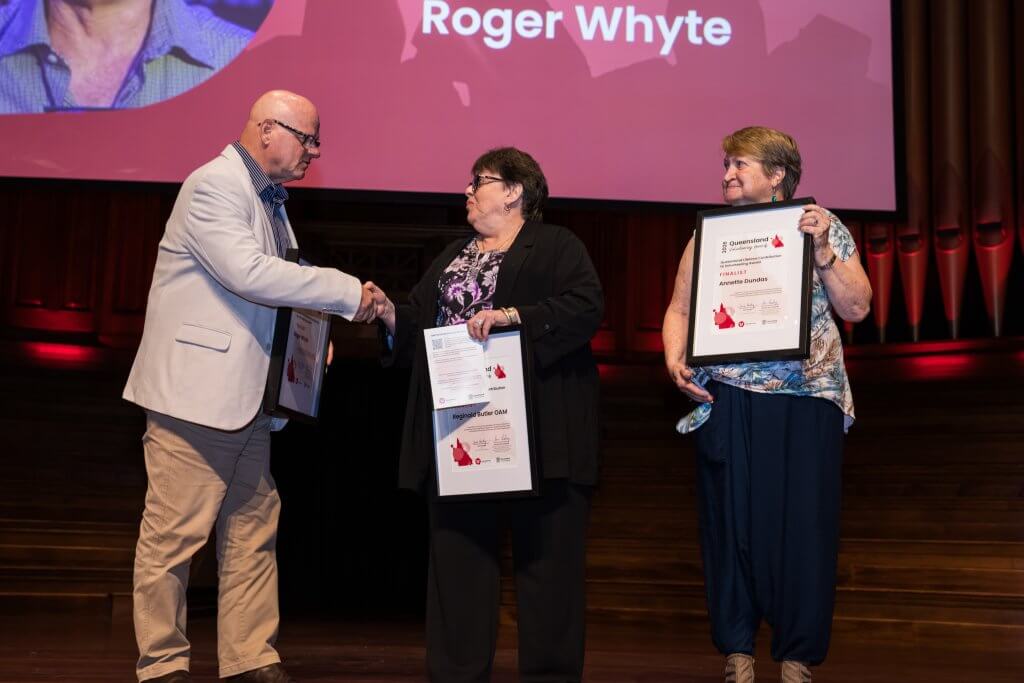
“You don’t volunteer your time because you want something in return. You volunteer your time because you’re dedicated and inspired by the fact that you’re obligated to give back to your community.”
Roger describes his volunteering efforts as an obligation, not as a burden, but a calling.
“I believe firmly that one is obligated to help. Whilst people can’t do everything, you are still obligated to lift a finger.”
“The actual character of a person are those that are struggling themselves, and yet they still find time for other people.”
For Roger, the gap between someone who transforms a community and someone who doesn’t isn’t talent, or resources, or extraordinary circumstance. It’s the quiet, persistent decision to see obligation where others see nothing at all, and then to act on it, week after week, year after year, decade after decade.
“There’s a million Rogers out there,” he says. “And they’re not as good looking as me. But they’re out there.”