



Article written by Lucy Stokes
Walk through the doors of Sunshine Coast University Hospital on any given morning and the first thing you will notice, alongside the sheer scale of the building, is a person in a purple vest, someone with no medical training giving up their own time out of nothing more than a genuine wish to help, simply to make sure you find your way. That small, unremarkable moment, repeated thousands of times a day across five hospitals, is the entire engine of a program that was named Queensland Volunteering Government Impact Award for 2026.
For Michelle Acworth, who has steered the Sunshine Coast Hospital and Health Services Volunteer Program since 2015, the recognition is gratifying but almost beside the point. What matters, she insists, is what sits underneath it: around 189 volunteers, contributing upwards of 22,000 hours a year, held together by a program that has been quietly perfecting its craft for more than two decades and shows no sign of slowing down.
The story of the program is, in many respects, the story of the Sunshine Coast itself. When Michelle assumed the role in 2015, the service comprised a handful of regional hospitals with a modest volunteer cohort. Then, in 2017, Sunshine Coast University Hospital opened its doors, and the entire landscape was transformed.
“We grew from about 30 to 60 volunteers to over 300 at the time,” Michelle explains.
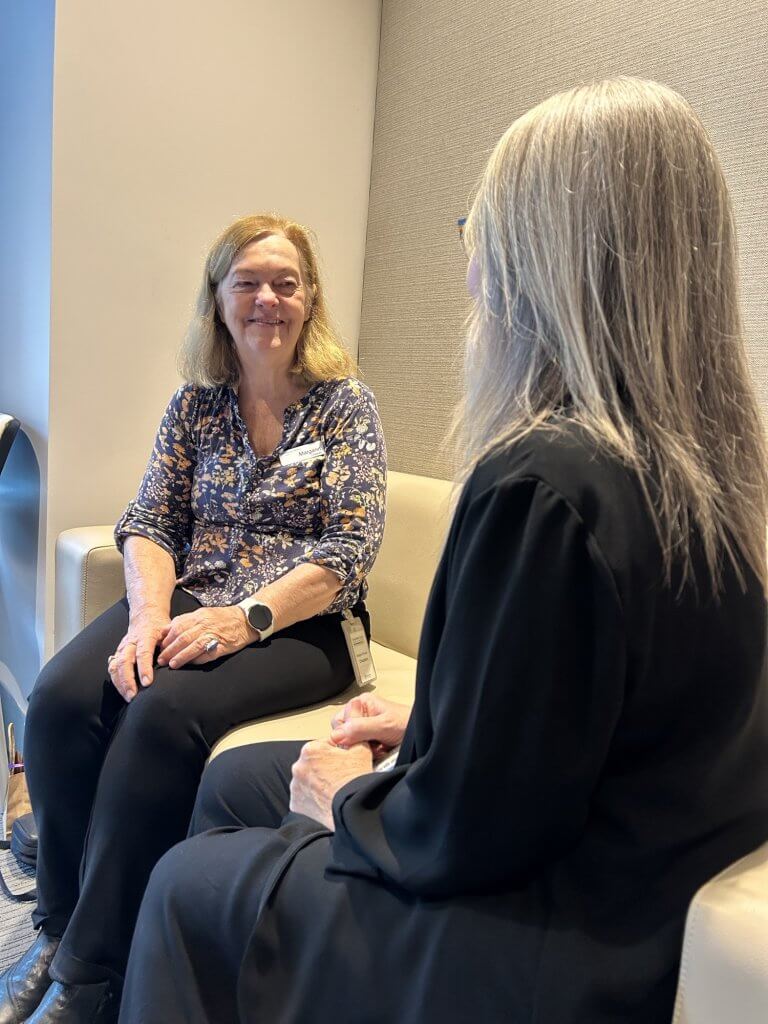
In the years since, that figure has been deliberately distilled back down to around 189, not because appetite waned, but because leadership made a considered judgement to prize substance over sheer volume.
“We’re really focused on what the volunteers are doing and using their time more valuably, making sure their roles suit their requirements and what they want to get out of it as well.”
That single reflection captures something essential about the philosophy underpinning this program. It was never conceived around filling rosters. It was conceived around people, both the volunteers offering their time and the patients, families and staff on the receiving end of it.
Today, the program operates over three main functions. There are the Sunshiners, a sprawling cohort of general volunteers who greet visitors, guide people through an often-bewildering building, sit vigil at the bedside, vet and sort donated items and quietly keep the machinery turning behind the scenes. There is the hospital’s multi-faith Spiritual Care service, which accompanies patients, families and staff through some of the most consequential moments a life can hold. Finally, there is the Justice of the Peace and Commissioner for Declarations team, delivering a trusted, accessible civic service from a desk inside the hospital itself. Each function of the volunteer program answers its own regulatory demands, and yet, as Michelle frames it, all three are unified by a single underlying ethos.
“I think we are family, we support each other, most importantly, we respect each other.”
It would be tempting to assume that a program this warm, this personal, this evidently cherished by those people inside it, might be a little loose at the seams. The opposite proves true. Over recent years, Michelle has turned her attention to the scaffolding beneath the program: the frameworks, the compliance benchmarks, the documentation that quietly ensures every volunteer who crosses the threshold is supported, safeguarded and set up to flourish.
“We’ve recently created a central governance manual that says this is who we are, what we do and what we have to do to comply,” she says. That document then cascades into every department the Sunshiners touch, right down to the bespoke, department-specific guidance for something as minor as how to open a conversation upon first entering a patient’s room, a moment that, for an uninitiated volunteer, can feel unexpectedly daunting.
What is most striking, Michelle notes, is that none of this governance has left volunteers feeling weighed down by red tape. If anything, the effect has run in the opposite direction entirely.
“They’re not seeing it as red tape. They actually see it as ‘look what we’re doing’. We’re formalizing it, and we’re governed, and we get awards for it.”
The program’s award citation distils this precisely: a values-driven initiative, aligned to the National Standards for Volunteering, that regards its volunteers as integral to patient care rather than a peripheral nicety.
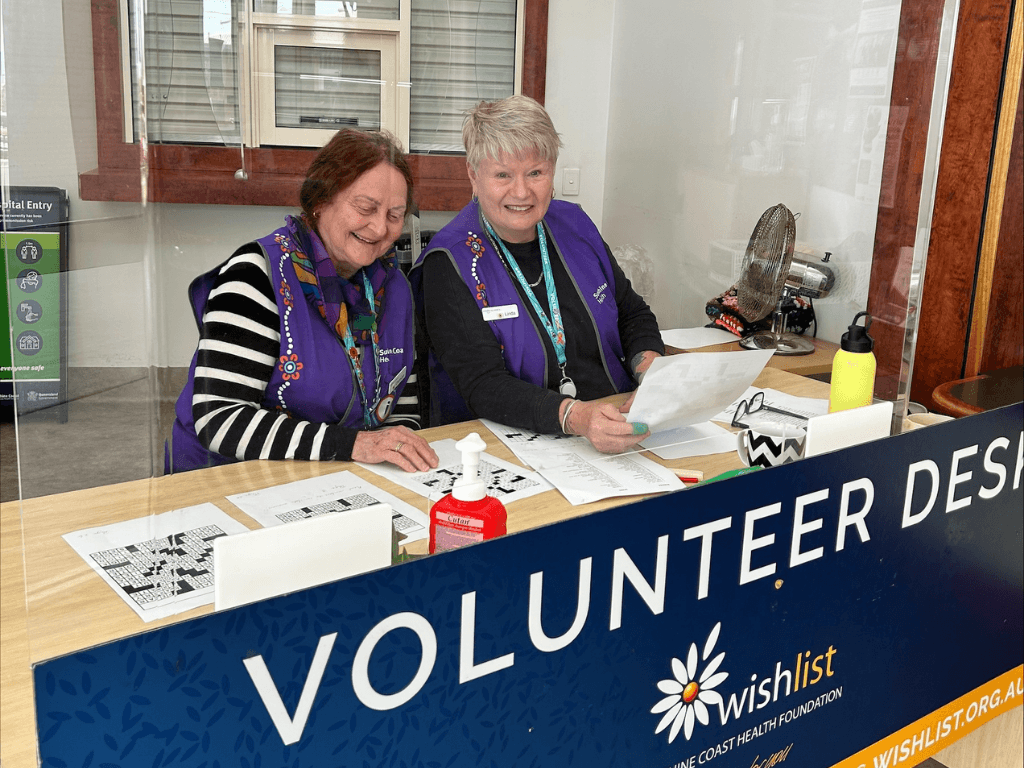
There is a particular kind of confidence that healthcare volunteering seems to cultivate, a quiet transformation that happens gradually, almost without the volunteer noticing, as showing up week after week turns into belonging, and belonging turns into something closer to purpose. Michelle has watched that transformation unfold most vividly in one volunteer in particular.
The volunteer arrived at Sunshine Coast University Hospital in its inaugural year, 2017, shy and reticent, someone who would come in, complete her hours and quietly disappear again. Around twelve months later, word reached Michelle that this volunteer’s seventieth birthday was approaching, and a handful of fellow volunteers wanted to mark the occasion. It was only then that the team learned that in seventy years, she had never once had a birthday party of her own.
“She has a heart of gold,” Michelle says, “and she now runs the show two days a week.” The shy, reticent volunteer who once slipped in and out without a word has, over the years, well and truly come out of her shell.
People come to volunteering for all kinds of reasons and part of what makes this program work is that it never asks anyone to justify theirs. Some arrive looking to fill a spare afternoon, others chasing a sense of purpose, or a return to the workforce, or simply the company of people who are glad to see them. Whatever brought her through the doors that first year, what has kept her there is a community that looks out for her in return. Volunteering has given her a community that delivers fruit baskets during hard times, offers her a lift home when the weather turns unkind, and gives her a place to keep giving back even at Christmas, when the hospital shuts down for a fortnight, she is always among the first to ask if she can still come in.
“To watch her grow and just blossom over these ten years, it just melts my heart. She’s so amazing.”
It is a story that speaks to something larger about volunteering itself: that the exchange is never unilateral, and that those who give their time so often receive something equal, if not greater, in return.
That reciprocity is perhaps easiest to see in what happens when it disappears. If you want proof of how thoroughly volunteers have woven themselves into the fabric of this institution, you need only to examine what transpired when they were gone. During COVID, volunteers were among the first cohorts who were stood down, deemed peripheral to the treatment of patients, and the effect was immediate and unmistakable.
“It was very quiet, a bit cold. You walk through the door to a volunteer welcoming you and all of a sudden it was missing.”
Staff noticed too, and not merely in terms of workload, though there was plenty of that. Countless small tasks previously absorbed quietly by volunteers now failing back on clinical teams already stretched thin. What stuck Michelle most profoundly was the personal nature of the absence.
“They do miss them, but they don’t just miss them for the work, they miss them as people. They check in with us and say, we haven’t seen Wendy and Graham for a couple of days, are they okay?”
That mutual respect between staff and volunteers goes some way towards explaining a statistic that sets this program apart from most others in the sector. Volunteer turnover is one of the most persistent, most quietly damaging challenges confronting almost any organisation reliant on unpaid time, and it is here at the Sunshine Coast program distinguishes itself most decisively. Average tenure across the service sits at nearly eight years, soon to eclipse the decade mark for the very first cohort who joined when the university first opened its doors. In a sector where many programs struggle to retain volunteers for even a fraction of that duration, the figure is nothing short of remarkable. Michelle attributes it, without much hesitation, to leadership and a genuine, unperformative investment in people.
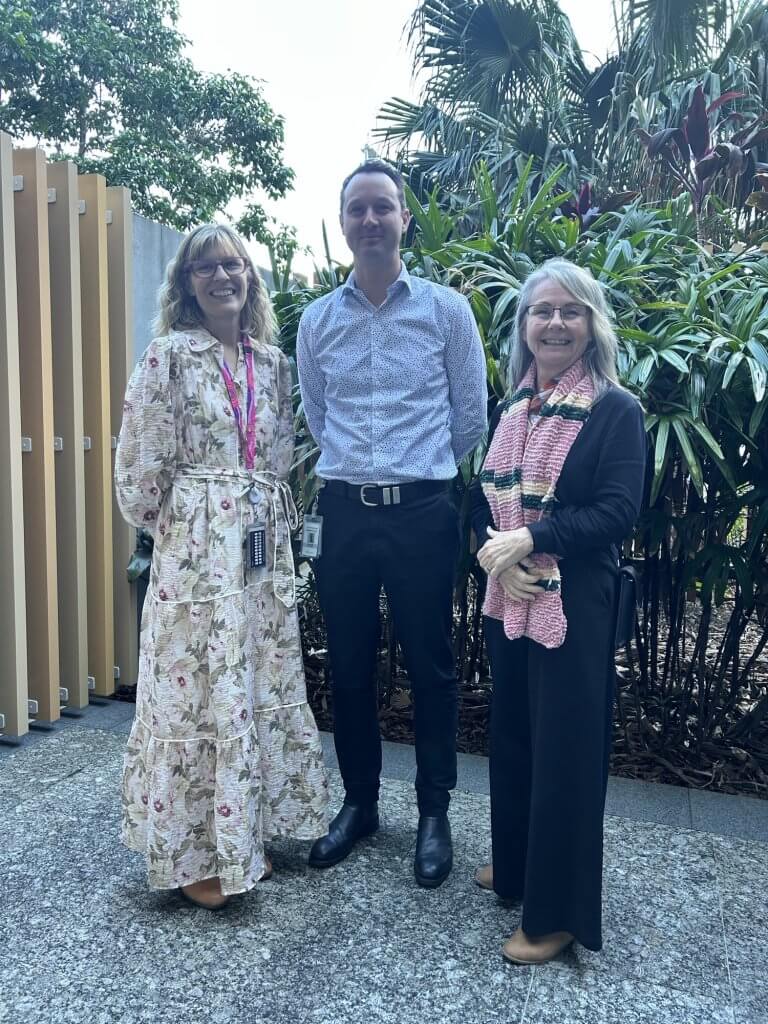
“We really invest in our team. We invest in what’s happening in their life, what’s happening in the hospital. We invite them to talk to us; we listen to them and take on board their ideas.”
It is a deliberately collaborative ethos, one that regards volunteers not as a workforce to be administered but as partners to be accompanied. “We walk beside them.”
Training, too, has been reimagined in service of the same philosophy. Rather than cosigning volunteers to generic, impersonal online modules, Michelle and the team deliver the sessions themselves, drawing on decades of lived experience within Queensland Health to render the content feel real and relevant. Beneath all of it lies something considerably harder to formalise in any policy document: a team that simply, wholeheartedly loves what it does. “I think the fact that we love it too, like we love what we do, and it’s not hard to come to work. We love coming to work. We love where we work, the people we work with. And I think that’s infectious.”
“It’s only because this team has given us the confidence that we can expand and really focus on that,” she says. “Without a great team, I wouldn’t be able to do it.”
For anyone weighing up whether to put their hand up, Michelle’s counsel is simple, delivered with the conviction of someone who has watched hundreds of people walk through that door and emerge transformed.
“Be patient with the process. It is absolutely worthwhile. You will make lifetime friends, build social skills, and connect with people in your community. You learn so much about yourself and others as well.”
Interested in volunteering with the Sunshine Coast Hospital and Health Service? Roles are advertised through SEEK Volunteer, or you can register your interest directly at SC-Volunteers@health.qld.gov.au.
For more information – Sunshine Coast Health