



Article written by Lucy Stokes
For Bridget Backhaus, volunteering in community radio was never about gaining work experience; it was about connection, voice, and discovering the power of community radio.
Now a senior lecturer in journalism and media studies at Giffith University, Bridget completed her PhD with the thesis of ‘Listening to the listeners: Intersections of participation, voice and development in community radio’.
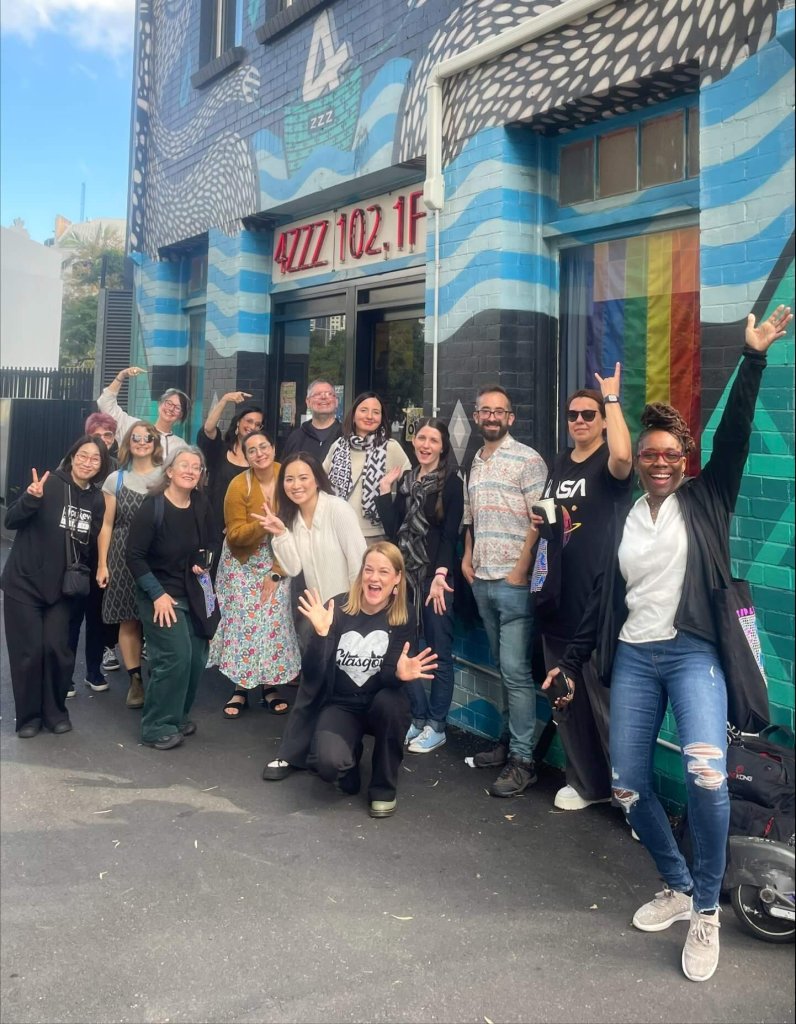
Like many aspiring journalists, Bridget first turned to community radio while studying journalism. Beginning as a volunteer at 4ZZZ, one of Australia’s longest-running community radio stations, she gained the experience and love for community radio that turned into further research and a fulfilling career.
The need for experience coupled with the eagerness to build skills made community radio the perfect setting for her career to flourish. She explains that community radio gives people the freedom and opportunity to express themselves, fostering learning for young professionals.
“You are so much closer to your audience, you have a voice but you’re also a part of the community you are engaging with, it’s a really unique learning space.”
As well as nurturing up-and-coming journalists, the overall media environment is so much more diverse and different from traditional newsrooms.
Her time spent volunteering at 4ZZZ led Bridget to step into leadership roles, eventually supervising volunteers in the newsroom of The Wire, a national current affairs program produced by community radio stations across Australia.
That experience became one of the most rewarding parts of her career.
“It was incredibly rewarding to mentor emerging journalism students,” she says. “Talking them through edits, helping them present their stories, and teaching community journalism skills.”
For Bridget, mentoring volunteers was also about paying forward the support she once received herself.
“I got great mentoring when I started at 4ZZZ, and it felt really valuable to pass that on.”
Through her work with volunteers, Bridget became increasingly interested in the idea of voice and who gets to be heard in the media. Community radio, she says, offers something unique.
“Everyday people get a chance to have a voice. You can’t really find that anywhere else.”
Across Australia, roughly 17,800 volunteers contribute to community broadcasting. According to the sector, there are more than 450 community radio stations nationwide, reaching almost five million listeners every week.
It is important for communities to feel empowered by having a voice for their culture, language, and identity. These stations represent an extraordinary range of diverse voices. At Brisbane’s multicultural station 4EB, for example, programs are broadcast in around 80 different languages, helping communities stay connected to culture, information and one another.
Community radio is contingent on volunteers who grew up listening to radio, with a large diversity in the age of volunteers. Bridget has seen many volunteers join stations after retiring from full-time work, looking for purpose and connection. Retired volunteers don’t just give their time but do so to fulfill lifelong dreams, following passions they weren’t able to pursue in other disciplines.
“People who grew up listening to radio often come back to it,” she says. “When they retire, they’re looking for something meaningful to do.”
Often, they find much more than they expected.
“People make lifelong friendships,” Backhaus says. “They find community connection and find their people.”
Bridget highlighted the impact of community radio through a story shared by one of her research participants, who was approached by a listener that recognised her voice and stopped to thank her.
“In community radio there’s this shared voice and connection through media,” she reflects on the encounter.
Despite its impact, community radio faces ongoing challenges. Much of the work that keeps stations running is done by volunteers, who often juggle broadcasting with fundraising, grant writing and administration.
“Volunteers invest so much time chasing grants and sponsorship,” Backhaus says. “It takes away from the work they really want to be doing.”
She believes greater recognition and funding for community broadcasting would help support the sector and the volunteers who sustain it.
At the same time, she encourages community stations to share their successes more widely.
“We need to sing our own praises and talk about the amazing work being done,” she says.
For those considering volunteering, Bridget has a simple message: give it a try.
“You would get so much out of it,” she says. “Anyone with even a vague sense of creativity should get in touch with a community radio station.”
The rewards extend far beyond learning how to broadcast.
“It’s about making friends, finding community, and giving back,” she says. “And having a lot of fun along the way.”
For Backhaus, community radio continues to demonstrate something powerful: when people are given a platform to share their stories, entire communities become stronger.
And sometimes, all it takes is a volunteer and a microphone.
You can learn more about 4EB and its work in community broadcasting here. Having been based at the station while working with The Wire, it has played a meaningful role in shaping this community radio journey.
4ZZZ is a community made up of dedicated volunteers. There are a number of ways you can participate from volunteering to events to internships in news, production or music departments. Find out more about 4ZZZ and how you can support its mission at 4ZZZ – Community Radio Brisbane.